
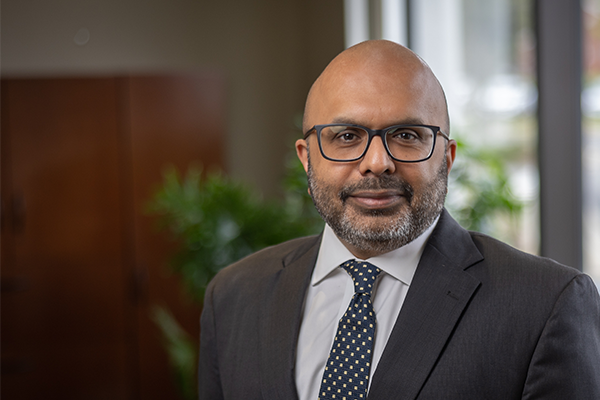
North Carolina Department of Health and Human Services Secretary Devdutta Sangvai, MD, joined Adrian Hernandez, MD, executive director of the Duke Clinical Research Institute (DCRI), and Manesh Patel, MD, chief of Duke’s Divisions of Cardiology and Clinical Pharmacology, for a fireside conversation about leadership, the state of public health, and the future of clinical research. It was held on March 31 as part of DCRI’s 30th Anniversary Research Forum Series.
As an experienced primary care doctor and distinguished leader of health education, Sangvai, professor emeritus of Family Medicine and Community Health and current vice president for population health management at Duke University Health System, provided unique insights about the combined importance of clinical care, community engagement, and public policy.
Sangvai has a long history of driving positive change. Since arriving at Duke in 2001, he’s held several notable positions that allowed him to help others well beyond the clinical setting.
“That traditional faculty role exposed me to this idea of how we can create opportunities for efficiency and data sharing, to improve clinical outcomes,” he said.
Sangvai emphasized the importance of grounding clinical research in the lived experiences of patients and communities. “We have to design systems that meet people where they are—not where we wish they were,” Sangvai said, noting that a top priority for the Department of Health and Human Services is enhancing the quality of care in rural areas of the state.
He urged academic institutions to continue to prioritize scientific advancement and discoveries that improve access and health outcomes and are responsive to the needs of the people they are meant to serve. “If people don’t trust the system delivering the care, then even the best evidence won’t reach the people who need it,” he said.
As a physician dedicated to providing life-enhancing care, Sangvai also underscored the need for studies to be inclusive, accessible, and relevant to everyday health care. “If our research efforts aren’t making it easier for patients and communities to be healthier, then we have to ask whether we’re solving the right problems,” he said.
Hernandez, Sangvai, and Patel also touched on how aligning mission, data, and people, and maintaining clear priorities in research and innovation, is an effective way to navigate change in health care.
The conversation served as a reflection of DCRI’s anniversary theme, 30 Years and Beyond: Shaping the Future of Clinical Research.