
Our residents learn to be competent, compassionate, and skilled family physicians in multiple inpatient, outpatient and community settings. They complete required rotations and have ample elective time to graduate prepared to pursue the type of career and practice they desire.
Population Health Improvement through Teamwork (PHIT) is a multi-pronged curriculum designed to teach Duke Family Medicine residents the competencies needed to collaborate with and lead population health improvement efforts that can include, but also go beyond, the management of patients in their clinics. The curriculum includes workshops, quality improvement activities, community health experiences, practice with new models of care, and a longitudinal project; the latter requires that residents use the tools of analysis and community engagement to further a community-based population health improvement initiative.
Together, the curricular components provide residents with experiences, skills, and knowledge in the four competency domains of population health: public health, community engagement, critical thinking, and teamwork/leadership. Family medicine faculty and students from the Duke University School of Medicine Primary Care Leadership Track, and others participate in portions of the curriculum alongside the residents.
We provide immersive outpatient training that is intentionally designed to provide maximum continuity for you with your patient panel. We are a hospital-based clinic but also care for many patients through an agreement with the public health department. . Most of our patients are medically complex, experience a high burden of social determinants of health, and navigate inequitable societal structures as they try to achieve optimal health. Residents gain in-depth experience partnering with these patients and within challenging healthcare environments.
In addition to our continuity clinic, you will also be assigned to a community clinic site starting in your PGY2 year. Once a week on most rotations you will spend time at this clinic site that is embedded within the community and designed to give you experience in alternative clinical settings so that you can better understand the different practice varieties available to you after you graduate. This both strengthens community partnerships and exposes you to other ways of practicing medicine.
Inpatient training is predominantly provided through the Duke Family Medicine Inpatient Service (FMIS) at Duke Regional Hospital (DRH). The teaching team consists of two junior residents paired with a senior resident, faculty, and oftentimes a student.. The FMIS team consists of both rural and university residents, providing an opportunity for the two FM residencies to cross-pollinate and support one another.
Our night float rotation is also at DRH and provides residents with a full spectrum experience, as they manage and admit adult medicine inpatients, triage and manage laboring obstetrics patients, cross-cover the newborn service, and take home call for the practice. This rotation is covered by both a senior resident and a junior resident working in close conjunction with the nocturnists.
Other inpatient rotations include two weeks of MICU at the Durham VA and four weeks of inpatient pediatrics at the Duke University Children's Hospital.
The geriatric rotation includes the Memory Disorders Clinic, among other opportunities run by the geriatrics division at Duke and the VAOur family medicine residents also provide continuity care for long-term residents at Pettigrew Rehabilitation Center in Durham.
The geriatric rotation includes the Memory Disorders Clinic, among other opportunities run by the geriatrics division at Duke and the VAOur family medicine residents also provide continuity care for long-term residents at Pettigrew Rehabilitation Center in Durham.
Obstetrics training is completed through two months at Duke Regional Hospital and includes both care of private, community patients as well as care of continuity patients managed by the Duke Family Medicine (DFM) Clinic. Prenatal care at DFM clinic is delivered via the Centering model with group prenatal visits led by residents. Residents are assigned to Centering groups so that the due dates align with when the resident will already be working in the hospital and therefore likely to be present for delivery. In this way, our residents easily attain continuity deliveries. High-volume OB training is possible in our program with the use of electives and we have multiple graduates who are practicing OB both with and without fellowship training
Starting in second year, residents rotate through the Duke Family Medicine (DFM) procedure clinics. These include two gynecology clinis (one with colposcopy and one without), a dermatology clinic, vasectomies, and circumcisions. Additionally, a gynecology rotation in second year allows for an immersive experience at Planned Parenthood where residents have the option to gain experience in providing medical or surgical abortion. This rotation also provides multiple experiences to develop skills in long-acting reversible contraception like IUD and Nexplanon placement and removal.
During the sports medicine rotation, residents will gain experience using musculoskeletal ultrasound for joint evaluation and injections at Duke Family Medicine as well as Duke Sports Sciences Institute. Specialized days also support basic skills in fracture management and splinting.
In close collaboration with Duke’s rural residency, this has been an increasing focus for both residencies in recent years. We currently support this with structured didactics sessions every 5th Tuesday, as well as longitudinal integration into both the outpatient and inpatient setting. We have butterflies at all locations where there are residents, and regularly provide faculty development in their use so that residents will feel supported by their teachers.
Duke Family Medicine Sample Residency Schedule
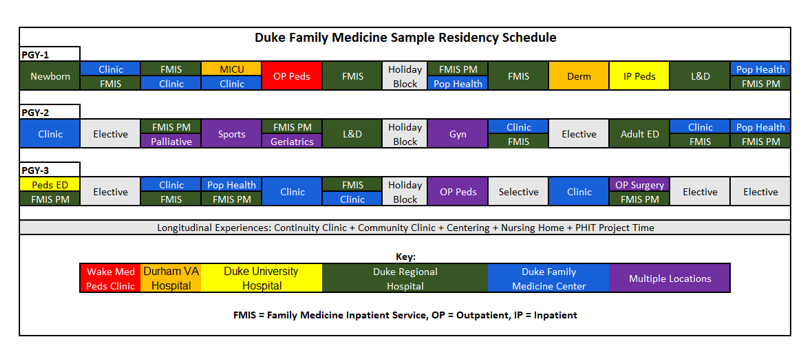
The curriculum spans three years of residency training: PGY1, PGY2, and PGY3, with each year including a variety of clinical rotations across multiple healthcare sites.
PGY-1 (Post-Graduate Year 1)
- Newborn
- Clinic
- Family Medicine Inpatient Service (FMIS)
- Clinic
- Medical Intensive Care Unit (MICU)
- Outpatient Pediatrics (OP Peds)
- FMIS
- Holiday Block
- FMIS PM (Evening Shift)
- FMIS
- Dermatology (Derm)
- Inpatient Pediatrics (IP Peds)
- Labor and Delivery (L&D)
- Population Health PM
PGY-2
- Clinic
- Elective
- FMIS PM Palliative Care
- Sports Medicine
- Labor and Delivery (L&D)
- Holiday Block
- Gynecology (Gyn)
- Clinic
- FMIS
- Elective
- Adult Emergency Department (Adult ED)
- Clinic
- FMIS
- Population Health
PGY-3
- Pediatric Emergency Department (Peds ED)
- FMIS PM
- Elective
- Clinic
- FMIS
- Population Health
- FMISP M (Morning Shift)
- Clinic
- Holiday Block
- Outpatient Pediatrics (OP Peds)
- Selective
- Clinic
- Outpatient Surgery (OP Surgery)
- FMISP M
- Elective
- Elective
Longitudinal Experiences
- Continuity Clinic
- Community Clinic
- Centering
- Nursing Home
- PHIT Project Time
Rotation Sites
- Wake Med Hospital
- Durham VA Hospital
- Duke University Hospital
- Duke Regional Hospital
- Duke Family Medicine Center